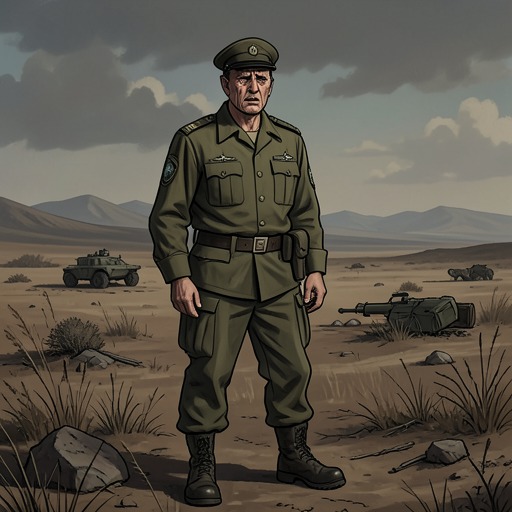
Yamamoto’s secret mission across the Khalkha River
The Wind-Up Bird ChronicleYamamoto’s secret mission across the Khalkha River begins as a covert border expedition disguised as research and mapping. In 1938, Yamamoto led a four-man party into a disputed wilderness where military geography, concealed crossings, and a missing document made the uncertain frontier a matter of immediate danger. The episode also lays groundwork for the Battle of Nomonhan and, in Lieutenant Mamiya’s retrospective account, for his later loss of faith in political ideologies and the institutions that served them.
A peaceful posting and an undisclosed assignment
Lieutenant Mamiya recalls his posting in Hsin-ching as deceptively comfortable. While officers lived comparatively easy lives, the war in China expanded, casualties increased, and relations with America deteriorated. This local calm belonged to a wider conflict that the Japanese military could not simply ignore. In late April 1938, a senior General Staff officer summoned Mamiya and introduced Yamamoto, a civilian officially hired to investigate the lives and customs of Mongolians in Manchukuo. The cover story assigned him to travel to the Hulunbuir Steppe near the Outer Mongolian border with an armed escort.
Mamiya immediately doubted that Yamamoto was an ordinary civilian researcher. His bearing and manner suggested a professional soldier, perhaps a senior officer or an intelligence operative concealing his military identity. The assignment was ominous in part because its real purpose was not explained to the men expected to carry it out.
The escort was deliberately small: Mamiya, the only officer, Sergeant Hamano, and Corporal Honda. Hamano had combat experience and was regarded as the detachment’s dependable fighting strength. Honda, recently arrived from home and apparently gentle and untested, had been specially transferred from the Seventh Division; Mamiya did not then know why the army considered him valuable. The party’s limited size could avoid drawing attention from Outer Mongolian forces, but it also left the mission with little obvious capacity for a fight.
Maps, borders, and the crossing
Mamiya commanded the escort because his duties concerned the topography of western Manchukuo near the Khalkha River. The existing maps of the Hulunbuir border region were crude, and he had been assigned both to check them against the terrain and to collect more precise information. Those surveys had military value: a combat map needed to show where troops could camp, where artillery could be placed, how long an infantry march would take, and where water and horse feed could be obtained.
The border remained deliberately ill-defined. Manchukuo shared sensitive frontiers with the Soviet Union and Outer Mongolia, and earlier disputes had already led to armed clashes. The Kwantung Army was committed to the war in China and lacked the divisions, tanks, artillery, and aircraft for a major conflict with the Soviet Union. It therefore preferred to postpone a definitive border settlement rather than provoke an international incident. Yet if war came despite that policy, detailed military maps would be indispensable. The expedition’s surveying work thus overlapped with intelligence gathering, even as its precise connection to Yamamoto’s mission remained unclear to Mamiya.
After five days of preparation, the party traveled by train from Hsin-ching to Hailar, then by truck toward a Manchukuo Army observation post near the river. From the post, they proceeded south along the Khalkha. Yamamoto spoke little beyond technical exchanges about the terrain, but his exact knowledge of the area led Mamiya to suspect that he had traveled there before.
After two days without incident, Yamamoto announced that the detachment would cross the river before dawn. Mamiya objected: the opposite bank was Outer Mongolian territory, where their presence would constitute an unmistakable border violation. A swollen river, fed by melting snow, made the crossing dangerous as well. Yamamoto said the highest levels of the army had approved the operation, accepted responsibility, and assured Mamiya that a hidden crossing point was usable. He also said that he had crossed there before.
The concealed ford consisted of a plank bridge held by ropes beneath the fast current, hidden from casual view and from reconnaissance aircraft. Yamamoto crossed first, then the others followed by holding the ropes as they and their horses struggled through the water. The far bank rose higher than the side they had left. That elevation would later matter at Nomonhan, where it gave the Soviet Army an advantage and affected artillery accuracy. Once across, the party removed its rank insignia; Mamiya also changed out of his officer’s boots. These precautions reflected the danger of capture in enemy territory, where the expedition had no defensible public explanation.
Capture and the contested document
The party did not complete its mission without being discovered. Mamiya’s account resumes with him waking to find Mongolian soldiers surrounding him and Yamamoto. Their tents had been found before the men could ford the river, and Honda and Hamano were nowhere in sight; Mamiya could not tell whether they had been killed or escaped. The patrol seized the party’s equipment and searched the prisoners and their belongings.
The search exposed the importance of a document that Mamiya had watched Yamamoto transfer from a saddlebag into a leather valise and place beside his pillow. The soldiers found only cigarettes in the valise. Yamamoto appeared momentarily unsettled by the document’s disappearance, but Mamiya understood that its not reaching enemy hands was the mission’s first priority. The seizure of maps, compasses, binoculars, weapons, and other equipment made the capture consequential beyond the fate of the men themselves: the detachment’s military information was now in hostile custody, while the document’s location remained unknown.
A Soviet Army officer later questioned Yamamoto in Russian and made clear that his side was also looking for the missing item. He reasoned that because the Japanese had not crossed the river, the letter must still be hidden on the near bank. He demanded to know why the party had entered territory belonging to the Mongolian People’s Republic. Yamamoto denied knowledge of a letter. The exchange confirms that the expedition involved a contested document and that Soviet authorities had prior knowledge of it, while leaving its contents and eventual fate unresolved in this account.
Historical consequences and Mamiya’s perspective
The crossing’s military geography acquires larger meaning in light of the Battle of Nomonhan the following year. The Khalkha’s riverbank and the higher ground on the far side were not neutral features: they shaped the positions and the effectiveness of artillery. The earlier surveying assignment, ostensibly a technical task, belonged to preparations for a possible war in a region where the border itself had been left vague for political convenience.
Mamiya’s later reflections place the mission against the collapse of Manchukuo and the wider record of wartime and postwar violence. He describes Japanese authorities abandoning border garrisons and civilian homesteaders as Soviet forces advanced, while Chinese soldiers in the Manchukuo Army deserted or rebelled rather than fight for Japan. He also condemns the killing of Chinese laborers during the construction of a secret base at Hailar. These recollections do not alter the immediate events of the 1938 expedition, but they make clear why Mamiya’s account refuses to treat military secrecy and border policy as detached technical matters.
After capture, Mamiya was interrogated and subjected to ideological training before being sent to a Siberian coal mine as an interpreter. He links his inability to believe in political ideology to what he had witnessed in Mongolia, to Japanese actions in Manchuria, and to the system of coercion and death in the mine. In retrospect, the secret crossing is one early episode in a history that discloses the human cost hidden behind military orders, intelligence work, and the management of territory. Its unresolved letter remains a thread of suspense; its more enduring consequence is the perspective it gives Mamiya on the institutions that claimed to act in the name of states and causes.